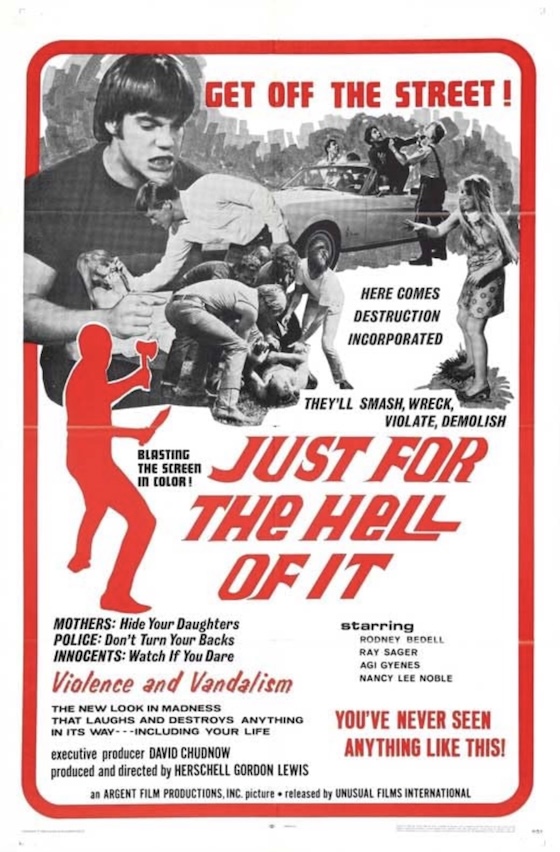
Just For The Hell Of It is about as pure a distillation of filmmaker Herschell Gordon Lewis’ anarchic, low-budget ethos as you can get.
There’s something uniquely unsettling about a film that refuses to justify itself, and Just for the Hell of It—directed by Herschell Gordon Lewis—does exactly that. No moral framework, no narrative payoff, no psychological depth. Just cruelty, repetition, and a kind of dead-eyed boredom that curdles into violence. It’s not shocking in the way Lewis’s gore films are; it’s worse. It’s indifferent.
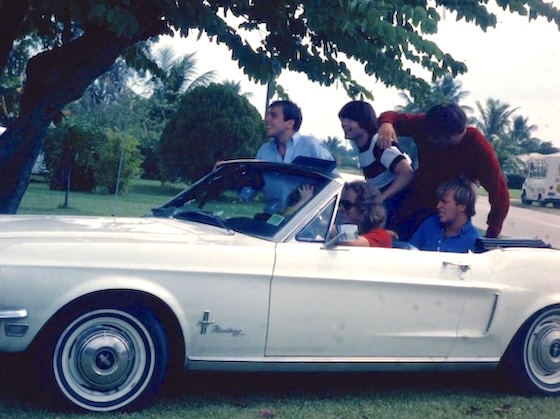
The film follows a group of teenagers—played by a cast of non-professional or little-known actors including Ray Sager, Shelby Livingston, and Steve Alaimo—who drift through a series of loosely connected episodes of vandalism, harassment, and assault. They smash property, terrorize strangers, and destroy for sport. There’s no escalation in the traditional sense, just accumulation. Scene by scene, the film becomes a catalog of meaninglessness.
Shot quickly and cheaply in and around Miami, the locations are ordinary—streets, storefronts, open lots—which only amplifies the discomfort. There’s no stylization to cushion what you’re seeing. The daylight settings, the flat compositions, the lack of cinematic polish all work against the viewer’s expectations. You’re not watching heightened fiction; you’re watching something that feels eerily adjacent to reality, like stumbling across behavior that shouldn’t be happening in plain sight.
And that’s where the film digs in. The discomfort doesn’t come from spectacle—it comes from the absence of meaning. The teenagers don’t rebel against anything. They’re not making a statement. They’re not even particularly expressive. They just act. Randomly. Repeatedly. Without consequence. It creates a hollow, almost numbing atmosphere where violence isn’t climactic—it’s routine.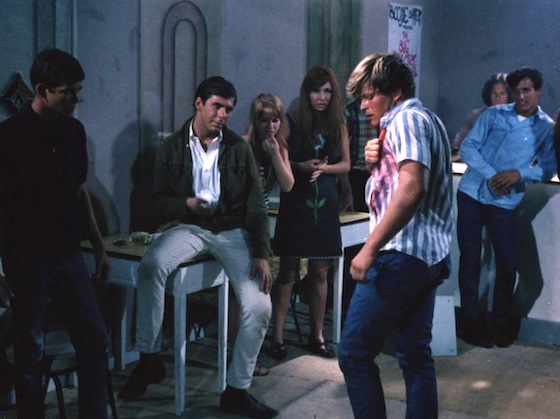
Lewis’s filmmaking style—usually associated with splatter and shock—here becomes something colder. The camera observes rather than provokes. There’s no attempt to glamorize or condemn. That neutrality becomes its own kind of provocation. You keep waiting for the film to tell you how to feel, or at least to suggest a reason for what you’re watching. It never does.
If there’s a “purpose,” it’s buried somewhere between exploitation and accidental commentary. On one level, the film clearly aims to capitalize on fears of juvenile delinquency that were prevalent in the late 1960s. But it overshoots that intention. By stripping away cause and effect, it turns those fears into something more abstract—less social warning, more existential shrug. Violence not as rebellion, but as default.
Watching it now feels less like engaging with a story and more like enduring a mood. It’s abrasive, repetitive, and often frustrating—but that friction is exactly what gives it staying power. Just for the Hell of It doesn’t want to entertain you. It wants to sit there, blankly, while you try to make sense of something that refuses to make sense at all.
And that’s the part that lingers. Not what happens—but how little it seems to matter.



Home Video Distributor: Arrow Films
Available on Blu-ray - November 10, 2020
Screen Formats: 1.85:1
Subtitles: English
Video: 1080p
Audio: LPCM Mono
Discs: Blu-ray Disc; seven-disc-set
Region Encoding: Locked to Region A
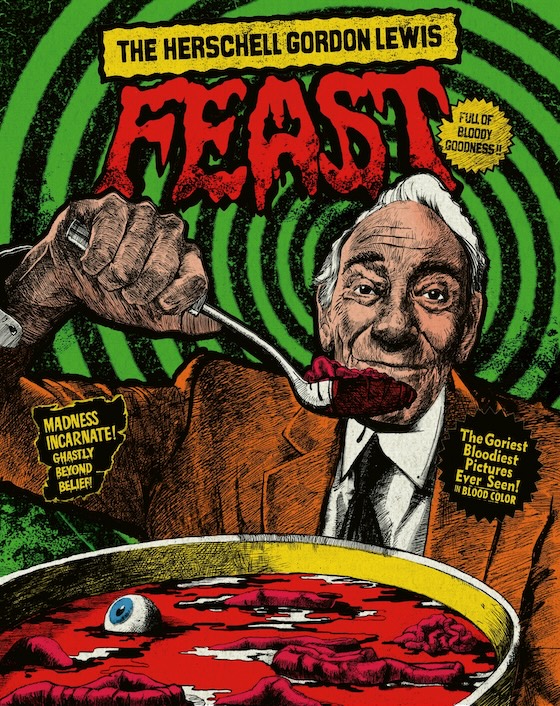
When Arrow resurrected the Herschell Gordon Lewis Feast Blu‑ray box set, it wasn’t just a re‑release — it was a full‑scale archaeological dig conducted by maniacs who love cinema too much to let its weirdest artifacts rot in the swamp. This set arrives like a grindhouse holy text, a lavish, oversized altar to the Godfather of Gore, packed with restorations so crisp you can practically count the brushstrokes on the latex intestines. Arrow treats Blood Feast and its deranged siblings with the reverence usually reserved for Bergman or Kurosawa, which is exactly the kind of cosmic joke H.G. Lewis would appreciate. The packaging is a riot of lurid artwork, the extras are deep‑cut academic fever dreams, and the whole thing feels like a lovingly curated museum exhibit dedicated to the moment American cinema shrugged off good taste and said, “Let’s see what happens if we show EVERYTHING.” It’s not just a box set — it’s a blood‑drenched celebration of outsider filmmaking at its most gloriously unhinged.
Video
The Arrow Video release of Just For The Hell Of It significantly improves the film’s presentation compared to older DVD versions by using a new high-definition restoration sourced from the best available film elements. While the movie itself remains a rough, low-budget exploitation picture, the Arrow Video upgrade makes the visuals noticeably clearer, with better contrast, sharper detail, and more stable colors that bring out the gritty biker aesthetic of the late-1960s production.
The improved transfer also helps preserve the work of director Herschell Gordon Lewis, presenting the film in a way that more closely reflects how it would have looked in theaters during the era. In addition to the upgraded image and sound, Arrow Video’s edition typically includes bonus features and contextual material that highlight the movie’s place within exploitation and biker film history, making the release valuable for cult film fans and film historians even if the movie itself is not considered a classic.
Audio
The Arrow Video release of Just For The Hell Of It also improves the film’s audio compared to earlier home-video versions. Arrow restored the original mono soundtrack and presented it in a cleaner, lossless format, reducing background hiss and distortion that were common in older DVD transfers.
While the dialogue and sound effects still reflect the limitations of the film’s low-budget 1960s production, the upgraded track makes voices easier to understand and gives the motorcycle engine sounds and music a fuller presence.
These improvements help modern viewers experience the film with clearer sound while still preserving the gritty, drive-in style audio typical of director Herschell Gordon Lewis and exploitation cinema of that era.
Supplements:
Disc Five of the Arrow Video set highlights both She-Devils on Wheels and Just for the Hell of It, providing several special features that help explain the films and their place in exploitation cinema. The disc begins with an introduction from director Herschell Gordon Lewis, where he discusses the background and production of the films. An audio commentary for She-Devils on Wheels allows Lewis to share stories about filming, the low-budget production process, and his approach to making independent exploitation movies in the 1960s. Other featurettes include “Garage Punk Gore,” in which filmmaker and musician Chris Alexander talks about Lewis’s influence on underground film and music culture, and “The Shocking Truth!” where editor and filmmaker Bob Murawski explains his admiration for Lewis and what he learned from studying his work. The disc also includes a segment of Lewis discussing his film The Alley Tramp, along with archival promotional material such as a radio spot and original trailers for both films. Together, these extras provide historical context and insight into Lewis’s filmmaking style and the era of low-budget drive-in exploitation cinema.
Commentary:
- See special features
Special Features:
DEVILS ON WHEELS (1968) & JUST FOR THE HELL OF IT (1968)
- Introduction to the films by director Herschell Gordon Lewis
- Audio Commentary on She-Devils on Wheels with Lewis
- Garage Punk Gore – filmmaker and musician Chris Alexander discusses the films and music of Herschell Gordon Lewis
- The Shocking Truth! – Bob Murawski on his lifelong love for Herschell Gordon Lewis and what he has learned from Lewis’ films
- Lewis on his 1968 film The Alley Tramp
- She-Devils on Wheels Radio Spot
- Trailers for She-Devils

| Movie |  |
|
| Video |  |
|
| Audio | |
|
| Extras | |
|
|
Composite Blu-ray Grade
|
||