Caroline Golum’s Revelations of Divine Love is a film that resists easy categorization, existing somewhere between historical adaptation, spiritual meditation, and handmade experimental cinema.
Drawing from the writings of Julian of Norwich—a 14th-century anchoress whose visions became the first known book in English written by a woman—the film approaches biography obliquely, which is where it will lose a lot of its audience. Rather than reconstructing a life from sparse historical records, Golum builds an interpretive space where faith, isolation, and artistic creation collapse into one another. The result is less a narrative in the conventional sense than a cinematic act of contemplation, one that mirrors the interiority of its subject.
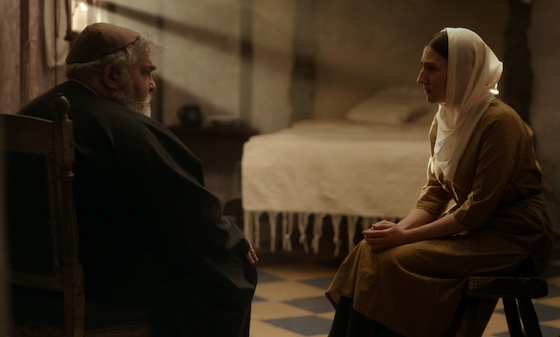
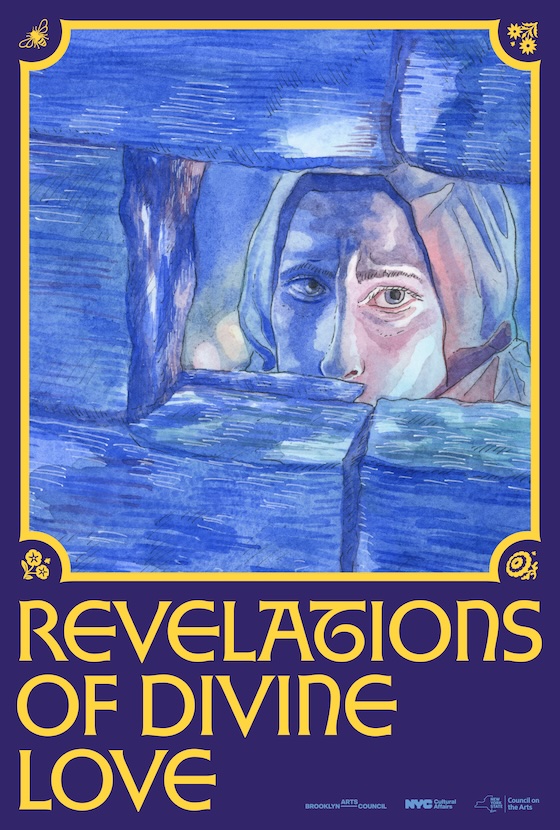
This means that the film is defined by its deliberate artificiality. Shot on handcrafted sets with visible miniatures and theatrical staging, Revelations of Divine Love embraces artificial aesthetics and favors construction over fooling the audience. Rather than undermining immersion, however, this stylization becomes the film’s primary expressive tool, evoking the visual logic of illuminated manuscripts and medieval iconography. The imagery often feels closer to living tableaux than cinematic realism, emphasizing texture, gesture, and symbolic resonance over spatial continuity.
Golum’s blending of historical and modern elements further complicates the film’s temporal identity. Synth-driven music, contemporary speech patterns, and subtle anachronisms coexist with period costumes and religious ritual, creating a productive tension between past and present. This suggests that the anxieties of Julian’s time—plague, political unrest, spiritual doubt—remain uncannily familiar. In this sense, the film becomes less about medieval life itself than about the persistence of human concerns across centuries.
At the center of this stylized world is Julian herself, portrayed with quiet intensity by Tessa Strain. Golum resists psychologizing her subject in conventional terms. The film offers little access to Julian’s inner life beyond her visions, which unfold in slow, ritualized sequences depicting Christ’s suffering and divine presence. These moments, often staged as static or minimally animated compositions, blur the line between religious revelation and artistic construction.
Sure, the film is light on plot and moves with an ethereal, drifting pace, favoring atmosphere and repetition over traditional narrative progression, but this by design; it’s a deliberate structure that echoes devotional practice rather than conventional drama. Scenes recur in cycles instead of building toward a climax, with gestures, sounds, and images returning in slightly altered forms. Meaning accumulates through duration rather than action, inviting the viewer to sit with moments long enough for them to deepen. The rhythm of bells, spoken text, and carefully staged tableaux becomes the film’s organizing principle, closer to liturgy than plot-driven storytelling.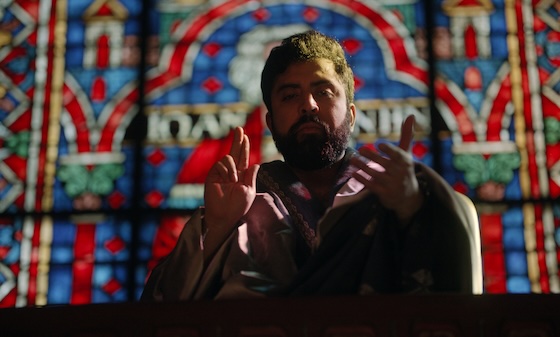
This pacing also heightens the film’s sense of constructedness. Without cause-and-effect momentum, each scene feels self-contained, like a living panel from an illuminated manuscript. Attention shifts to composition, texture, and gesture—the way bodies are arranged, how light shapes space, how time stretches within a frame. While this can feel distant or opaque to some viewers, it also opens up a different mode of engagement. By loosening narrative urgency, the film creates space for contemplation, asking the viewer not to anticipate what comes next, but to remain present within the image as it unfolds.
This emphasis on form and mood, however, comes at a cost. The theatricality that gives the film its distinctive texture makes it feel remote, as if the viewer is observing a carefully arranged installation rather than entering into a lived experience. The result is a work that invites intellectual and visual appreciation but occasionally struggles to generate a deeper emotional connection to its protagonist or her spiritual journey .
Still, Revelations of Divine Love stands as a striking example of contemporary independent filmmaking at its most singular. In an era dominated by polished historical epics and algorithmic storytelling, Golum’s film feels defiantly personal and idiosyncratic. It may not offer clear answers or conventional revelations, but in its devotion to process, texture, and spiritual inquiry, it achieves something rarer: a cinema of belief, where meaning emerges not through narrative clarity, but through sustained attention to the act of seeing.
Several Futures will open Caroline Golum's Revelations of Divine Love at Anthology Film Archives on March 27, showing alongside the series Revelations of the Middle Ages. Following a limited engagement at Anthology, it will continue with screenings in New York at Nitehawk Prospect Park (April 5), Low Cinema (April 11), Roxy Cinema (April 17-April 19, April 24-April 26), and Spectacle (April 24-26)—with Golum and special guests in attendance for all showings.
It will be available through On Demand platforms after that.


MPAA Rating: Unrated.
Runtime: 73 mins
Director: Caroline Golum
Writer: Laurence Bond; Caroline Golum
Cast: Tessa Strain; Theodore Bouloukos; Isabel Pask
Genre: Drama | History
Tagline:
Memorable Movie Quote: "Daughter, I brought you an image of our savior."
Distributor: Cinema Firmament
Official Site:
Release Date:
DVD/Blu-ray Release Date:
Synopsis: Adapted from the 14th-century memoir of mystic and philosopher Julian of Norwich, this account of religious ecstasy, plague, and revolt is the first book in English authored by a woman.