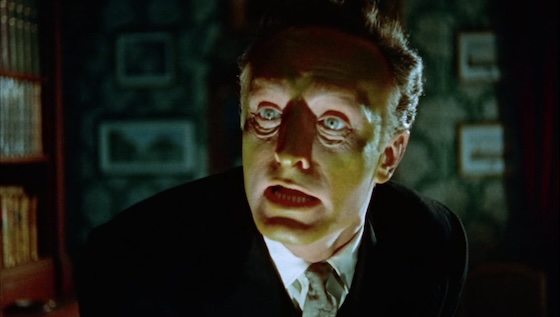
Hammer’s The Man Who Could Cheat Death is the kind of movie that feels like it was brewed in a Victorian alembic by a mad doctor who thought, “What if immortality required a little light surgery and a whole lot of candle smoke?” It’s Hammer in its transitional chrysalis—half Gothic melodrama, half philosophical doom spiral, all wrapped in that unmistakable late‑50s studio perfume of velvet drapes, brass instruments, and actors who look like they’ve been carved from marble and anxiety. Terence Fisher directs it with the calm assurance of a man who knows exactly how long to let a shadow linger before it starts whispering back.
Anton Diffring, as Dr. Georges Bonnet, doesn’t just play a man cheating death—he looks like he’s already halfway through the process. He’s all cheekbones and cold intellect, a porcelain demigod who’s convinced he can out‑logic the universe if he just keeps slicing open enough necks. Watching him glide through 1890 Paris is like watching a glacier flirt with people: slow, beautiful, and vaguely threatening. Hazel Court, meanwhile, brings that perfect Hammer blend of poise and steel, and Christopher Lee strolls in like a gothic thundercloud, radiating the kind of moral authority that makes you sit up straighter even in your own living room.
The film’s premise—youth preserved through parathyroid transplants every ten years—sounds like something a Victorian wellness influencer would pitch between laudanum ads, but Hammer treats it with a straight face that somehow makes it even weirder. Fisher leans into the theatrical origins of the story, letting scenes play out like duels of ego and dread. The surgery sequences aren’t graphic, but they hum with a clinical menace that feels more intimate than gore. It’s body horror by implication, the kind that crawls under your skin because it’s all too plausible in that “rich men will absolutely try this” kind of way.
Visually, the film is a feast of Gothic restraint. Hammer hadn’t yet gone full psychedelic with its color palette, but the seeds are there: the flicker of candlelight on stone walls, the lush greens and golds of Bonnet’s studio, and the way shadows cling to Diffring like jealous lovers. It’s a world where immortality feels tactile—like something you could reach out and touch, if you weren’t afraid it might touch back. And beneath all the elegance, there’s a pulsing anxiety about aging, vanity, and the terror of being forgotten. It’s a horror film that whispers rather than screams, but the whisper is cold enough to fog glass.
But the film isn’t without controversy, and, thankfully, you get both versions with this release. 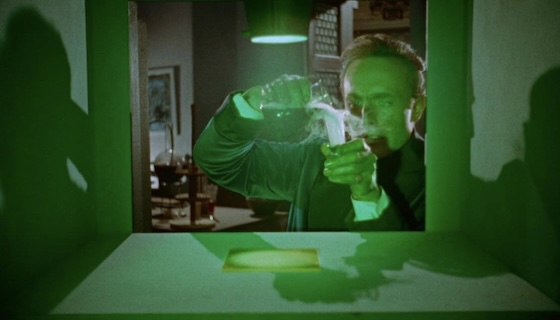
Hammer’s attempted nude modeling scene in The Man Who Could Cheat Death plays out like a Gothic‑era heist gone wrong: the studio sneaks in a tasteful, art‑pose nude moment, hoping to smuggle a little “continental sophistication” past the British Board of Film Censors, only for the BBFC to explode like a Victorian aunt fainting into a lace doily, shrieking that Hammer had already corrupted the nation with too much Technicolor blood; meanwhile, Paramount in the U.S. is standing off to the side yelling “More skin sells tickets!” like a carnival barker, so Hammer quietly hires a nude stand‑in for Hazel Court, films an alternate version for export markets, and buries it like contraband, creating decades of rumor, myth, and whispered legend about a forbidden “lost cut” that turned out to be about five seconds of extremely polite nudity—proof that the real drama wasn’t the scene itself, but the bureaucrats, distributors, and moral guardians all trying to out‑cheat death, decency, and each other in the grand Hammer tradition.
By the time the film reaches its climax—equal parts tragic, operatic, and morally inevitable—you realize Hammer wasn’t just making another Gothic programmer. They were dissecting the human fear of endings with a scalpel dipped in candle wax. The Man Who Could Cheat Death may not have the monsters or mayhem of Hammer’s more famous titles, but it has something stranger: a quiet, unnerving conviction that the real horror isn’t death at all, but the desperate, delusional belief that we can outrun it. It’s a film that lingers like a half‑remembered nightmare, elegant and unsettling in equal measure.
Vinegar Syndrome’s restoration of The Man Who Could Cheat Death feels like a small cinematic resurrection—fitting for a film obsessed with cheating mortality. Hammer’s 1959 Gothic thriller has always lived in the shadow of the studio’s more flamboyant Technicolor nightmares, but this release finally gives it the reverence and clarity it has long deserved. Terence Fisher’s direction, Anton Diffring’s icy charisma, and Christopher Lee’s aristocratic gravitas all emerge with a crispness that makes the film feel newly alive, as if the negative itself had undergone one of Dr. Bonnet’s rejuvenating gland transplants.
What’s most striking about revisiting The Man Who Could Cheat Death in this edition is how modern its anxieties feel. The film’s obsession with youth, vanity, and the terror of aging lands differently in an era of cosmetic procedures and biohacking. Diffring’s performance—cool, elegant, brittle—reads almost like a prototype for the contemporary antihero who believes he can out‑logic mortality. Vinegar Syndrome’s presentation sharpens these thematic edges, making the film feel less like a quaint Hammer curio and more like a surprisingly resonant meditation on the lengths people will go to to preserve themselves.
Ultimately, this release is exactly what boutique physical media should be: a rescue mission, a celebration, and a re‑framing. Vinegar Syndrome has taken a film that was often dismissed as “minor Hammer” and given it the kind of treatment that reveals its quiet strengths—its atmosphere, its performances, and its moral unease. For horror fans, Hammer devotees, or anyone who loves seeing overlooked films restored to their full, eerie beauty, this edition is a must‑own. It doesn’t just cheat death; it cheats obscurity.
This special limited-edition 2-disc 4K UHD/Blu-ray set comes with a spot-gloss hard split box + slipcover combo (designed by Tony Stella), includes a 40-page perfect-bound book, and is limited to 6,000 units. It is only available on Vinegar Syndrome and at select indie retailers. Absolutely no major retailers will be stocking them.



 Slipcover in Original Pressing / 4K Ultra HD + Blu-ray / Limited - 6,000 copies
Home Video Distributor: Vinegar Syndrome
Available on Blu-ray - November 25, 2025
Screen Formats: 1.66:1
Subtitles: English SDH
Audio: English: DTS-HD Master Audio 2.0 Mono
Video: Dolby Vision, HDR10
Discs: 4K Ultra HD; Blu-ray Disc; Two-disc set
Region Encoding: 4K region-free; blu-ray locked to Region A
In late nineteenth-century Paris, esteemed surgeon and talented sculptor Dr. Georges Bonnet is hiding an extraordinary secret—many years ago, he discovered the key to eternal life. Despite being 104 years old, he has the appearance of a man in his mid-30s. However, this incredible feat comes at a terrible cost, for every 10 years, Bonnet must undergo a surgery that requires the parathyroid gland of a living victim. When it becomes clear that his old friend and collaborator Professor Ludwig Weiss is no longer capable of conducting the surgery as he had previously, Bonnet kidnaps his old flame Janine Dubois in an attempt to coerce her new love interest, Dr. Pierre Gerrard, into taking up the task.
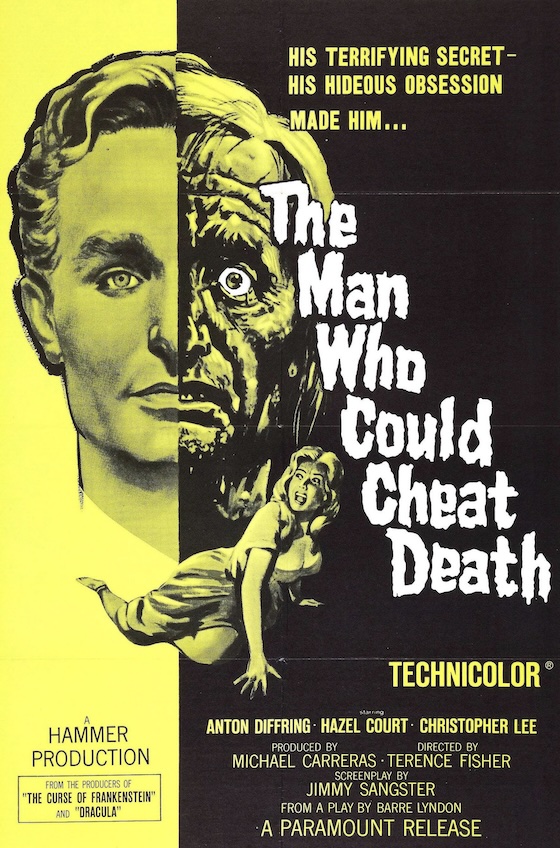
A joint venture between Paramount Pictures and Britain’s legendary Hammer Film Productions, which had just scored massive international hits with The Curse of Frankenstein (1957) and Dracula (1958), 1959’s THE MAN WHO COULD CHEAT DEATH saw director Terence Fisher return to the helm alongside writer Jimmy Sangster. With performances from Hammer stalwart Christopher Lee and Hazel Court (The Curse of Frankenstein)—whose topless scene fell foul of the UK censors, alongside a few seconds of the film’s fiery climax—Vinegar Syndrome is thrilled to present THE MAN WHO COULD CHEAT DEATH fully uncut for the first time on home video, newly restored in 4K for its world UHD premiere and stacked with new bonus features.
VIDEO
Hammer’s The Man Who Could Cheat Death hits the screen like a Victorian fever dream that’s been digitally exfoliated, caffeinated, and blasted with enough cinematic moisturizer to make even Dr. Bonnet’s parathyroid‑powered skincare routine look amateur; the whole thing glows now—candles burn hotter, shadows slither with purpose, Anton Diffring’s cheekbones could slice open the space‑time continuum, and Christopher Lee strides through the frame like a thunder god who accidentally wandered into a medical ethics lecture, all of it humming with that freshly‑polished, boutique‑label shimmer that turns a once‑dusty Gothic curio into a radiant, undead showpiece ready to stalk across your screen like it knows it’s finally beautiful.
AUDIO
Vinegar Syndrome’s audio upgrade hits The Man Who Could Cheat Death like someone finally cracked open the sealed tomb where Hammer’s sound engineers had been whispering for 65 years and let the whole mix breathe; suddenly the Parisian salons echo with real spatial depth, the clink of Bonnet’s surgical instruments lands with a metallic shiver that feels uncomfortably close to your own throat, and the score—once a polite Gothic murmur—now swells with a rich, velvety menace that wraps around the room like a velvet drape dipped in dread, turning every line delivery from Diffring, Court, and Lee into a crisp, resonant incantation that makes the whole film feel newly alive, newly dangerous, and newly convinced it really can cheat death after all.
Supplements:
Commentary:
-
Fans of this forgotten feature will be thrilled to hear the brand new commentary track with critics and authors Stephen Jones and Kim Newman!
Special Features:
The supplements deepen the experience rather than padding it. Vinegar Syndrome has a knack for curating extras that feel like conversations rather than lectures, and the commentaries and interviews here contextualize the film within Hammer’s transitional period. You get a sense of how the studio was experimenting with tone, pushing beyond the monster‑movie formula, and trying to craft something more psychological—more adult. The archival materials, too, are a delight, grounding the film in its theatrical origins and its earlier 1945 adaptation. It’s the kind of package that makes you appreciate the film not just as entertainment but as a cultural artifact with layers of history.
- 2-disc Set: 4K Ultra HD / Region A Blu-ray
- 4K UHD presented in Dolby Vision High-Dynamic-Range
- Newly scanned & restored in 4K from its 35mm original camera negative
- Presented in two viewing options on both the 4K UHD and BD:The uncut, pre-censorship "clothed" version and The alternate "nude" continental version
- Brand new commentary track with critics and authors Stephen Jones and Kim Newman
- "A Hideous Concoction" (26 min) - film historian Jonathan Rigby on The Man Who Could Cheat Death
- "The Man Who Could Direct Death" (24 min) - film historian Vic Pratt on director Terence Fisher
- "Court in Session" (17 min) - film historian Melanie Williams on actress Hazel Court
- "The Man Who Can Chat Death" (7 min) - an interview with uncredited third assistant director Hugh Harlow
- Alternate censored ending
- 40-page perfect-bound book with essays by: Adrian Smith, Jon Dear, and Kieran Foster
- Reversible sleeve artwork
- English SDH subtitles

| Movie |  |
|
| Video | |
|
| Audio |  |
|
| Extras | |
|
|
Composite Blu-ray Grade
|
||

MPAA Rating: Approved.
Runtime: 83 mins
Director: Terence Fisher
Writer: Jimmy Sangster; Barré Lyndon
Cast: Anton Diffring; Hazel Court; Christopher Lee
Genre: Horror | Thriller
Tagline: Incredible Horror Like Never Before!
Memorable Movie Quote: "What is death that it should be feared so much?"
Theatrical Distributor: Paramount Pictures
Official Site: Vinegar Syndrome
Release Date: June 17, 1959
DVD/Blu-ray Release Date: November 25, 2025
Synopsis: A centenarian artist and scientist, in 1890 Paris, maintains his youth and health by periodically replacing a gland with that of a living person.