The fluorescent lights hum like they’ve been left on too long. Somewhere, a clock ticks in rigid, mechanical time—unfeeling, inescapable. “Nine to Five” by Daniel Deluxe opens not like a song, but like a shift you never clocked into, its looping synth pattern mimicking the dull repetition of work turned ritual. There’s something distinctly 80s in its DNA—cold analog tones, a corporate dystopia filtered through neon and VHS grain—but it’s been stripped of nostalgia, leaving only the unease beneath it. What should feel familiar instead feels wrong, like a memory that’s been rewound too many times.
The beat locks in, steady as a timecard punch, while a low, pulsing bassline crawls underneath, suggesting something lurking just beyond the surface of routine. It’s the sound of monotony curdling into dread, of office walls closing in as the outside world fades into abstraction. In that sense, “Nine to Five” becomes the perfect entry point into the existential dread of Sometimes He Comes Back—a place where repetition isn’t comfort, but a trap, and where every cycle feels less like a day ending than something starting over again.
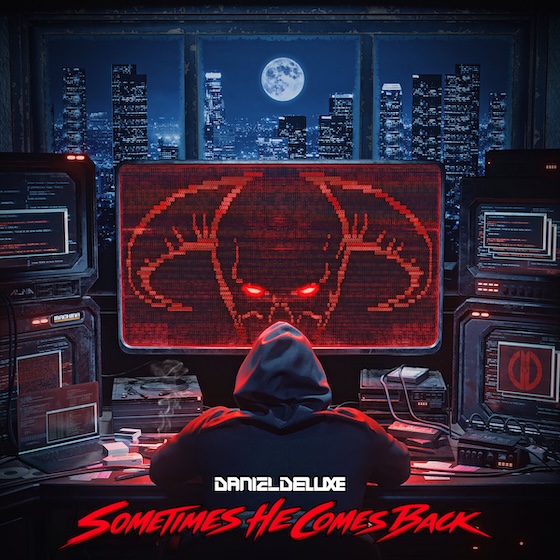
Operating in the shadowy intersection of synthwave and industrial horror, Daniel Deluxe has built a catalog defined by control, precision, and menace. Sometimes He Comes Back, his latest release, extends that identity into something even more filmic, playing less like a collection of tracks and more like a sequence of scenes stitched into a bleak, futuristic nightmare. Where earlier work leaned on brute-force aggression, this release refines his approach—favoring atmosphere, repetition, and negative space to create tension that lingers long after each track fades.
The album opens with “Realms Long Forgotten,” a slow, fog-drenched introduction that feels like the camera pulling back to reveal a ruined world. Its pacing is deliberate, built on low-end pulses and distant melodic fragments that suggest memory decaying into myth. The title track, “Sometimes He Comes Back,” follows with a more defined rhythmic spine, but it never fully erupts—its central motif loops with an almost ritualistic insistence, reinforcing the album’s core idea of recurrence. “Infamy” tightens the structure further, introducing a sharper, almost percussive drive, while “Free” briefly strips things down to something more skeletal and exposed, like a moment of false calm before the tension resumes.
Mid-album cuts deepen the sense of narrative drift. “Web of Sin” and “Levitation” feel like transitional sequences—less about forward motion and more about immersion, their textures stretching and warping as if time itself is unstable. “Chasing Shadows” and “Young Blood” inject a bit more propulsion, though even here the energy feels contained, as if constantly held in check. “Night Falls” marks a tonal pivot, leaning heavily into atmosphere and darkness, while “Cryo” introduces a colder, almost suspended quality, its sound design evoking stasis and isolation rather than movement.
The final stretch plays like escalation without release. “Synchronize” and “Kill Chain” bring a mechanical, almost procedural intensity—tight loops, rigid rhythms, and a sense of systems grinding forward without human intervention. “Nine to Five” stands out as a conceptual centerpiece, twisting something mundane into something oppressive, its repetitive structure mirroring the monotony of routine turned hostile. “Well of Illusions” feels like a descent, its layers folding inward, before “Dungeon” closes the record on its longest and most immersive note—less a finale than a deepening void, where the album’s themes collapse into pure atmosphere.
What ties these tracks together is their refusal to resolve. Instead of building toward climaxes, Daniel Deluxe lets motifs circle and recur, creating a sense that each piece is part of a larger, inescapable loop. It echoes the minimalist dread of films like Halloween and the cold, mechanical tension of The Terminator, where repetition becomes a form of psychological pressure. Sometimes He Comes Back doesn’t just evoke cinematic horror—it operates like it, unfolding scene by scene until you realize there was never going to be an ending, only the suggestion that it will all begin again.
Sometimes He Comes Back can be purchased here: https://danieldeluxe.bandcamp.com/album/sometimes-he-comes-back