Hold onto your butts!
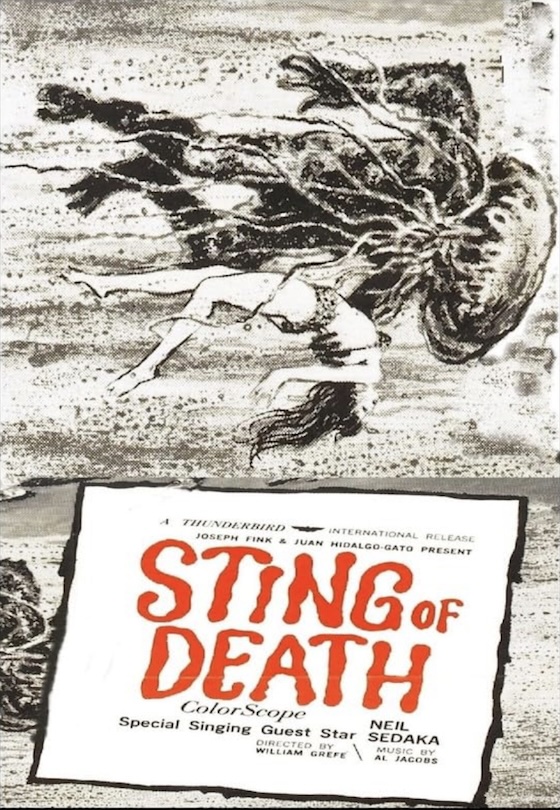
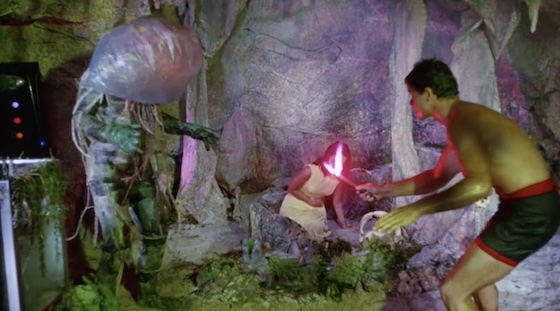
The first time you see the jellyfish man rise from the swamp in Sting of Death, it doesn’t feel like a monster reveal so much as a cosmic clerical error—like the Everglades accidentally burped up a creature it meant to keep buried under ten feet of primordial ooze. He comes wobbling out of the water, his translucent head‑sack pulsing like a nightclub jelly mold left too close to a speaker, and for a split second you swear the swamp itself recoils. The teenagers scream, the camera jitters, and the creature—God bless him—lifts his rubber‑gloved tentacles with the solemnity of a man about to deliver a sermon on the dangers of bullying and marine biology. It’s grotesque, it’s hilarious, and it’s the exact moment you realize you’re in the hands of a movie that has no intention of playing by the rules of nature, cinema, or common sense.
But even before that moment, there’s the dance party set to a rockin’ ska song. Oh, the ska dance party—that delirious, sun‑baked, brain‑melting interlude where Sting of Death stops pretending to be a monster movie and instead becomes a beach‑blanket fever dream orchestrated by someone who definitely inhaled too much swamp air. It erupts out of nowhere: one minute people are milling around, the next they’re skanking like their lives depend on it, hips jerking, arms flailing, everyone vibrating with the kind of manic joy usually reserved for cult initiations or tax refunds. And blaring over it all is that immortal earworm, “Do the Jellyfish,” a song so aggressively catchy it feels like it was engineered in a lab to haunt your bloodstream.
The camera doesn’t just film the dance party—it surrenders to it. It swirls, it swoops, it gets right up in the faces of these sunburned Floridians who are dancing like they’ve been promised immortality if they just keep moving. The whole thing has the energy of a high‑school pep rally held inside a tiki bar that’s slowly sinking into the marsh. And the best part? The monster is lurking nearby, watching this ska‑soaked chaos unfold, probably wondering if he should join in or just start stinging people mid‑two‑step.
It’s the kind of scene that makes you question whether the filmmakers were geniuses, lunatics, or both. It’s too earnest to be ironic, too bizarre to be normal, too joyful to be dismissed. It’s the moment the movie stops being a creature feature and becomes a cult artifact—pure, unfiltered, Everglades‑born absurdity. And honestly, it’s impossible not to love it.
Sting of Death doesn’t so much begin as it slithers into your lap like a damp beach towel someone forgot to wash for a decade. You’re dropped into the Florida Everglades, where the humidity is thick enough to chew and the teenagers are so aggressively upbeat you start rooting for the monster before he even shows up. And then—oh yes—he shows up. A man‑sized jellyfish creature with black rubber gloves, a pulsating head-sack, and the swagger of someone who absolutely believes this costume is working. It’s the kind of creature design that makes you question your own sanity, like maybe you’re the one melting in the sun.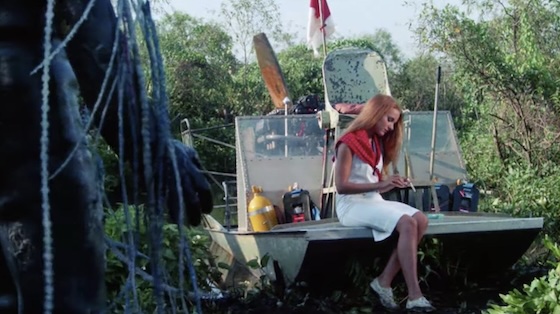
By the time the plot remembers it’s supposed to have one, we’re knee‑deep in mad‑scientist melodrama, doomed romance, and a killer who moves like he’s wading through invisible pudding. The attacks are a special kind of magic: victims flail, the soundtrack shrieks, and the monster wiggles his tentacles with the enthusiasm of a man who knows he’s getting paid in sandwiches. And then—because this film is a gift—there’s the dance party. A full‑blown, go‑go‑drenched, hip‑shaking beach sequence that feels like someone spiked the editing bay with swamp gas. It’s pure cinematic chaos, and it rules.
Somewhere in the muck, Sting of Death becomes weirdly earnest. The creature isn’t just a rubber menace; he’s a tragic outsider, a bullied scientist turned gelatinous avenger, a proto‑emo icon dripping with pathos and pond scum. The film wants you to feel for him, and against all logic, you kind of do. Maybe it’s the eyes (which you can’t see). Maybe it’s the performance (which you can’t parse). Maybe it’s the fact that he pilots a boat at one point, and you think, “Good for him.” Whatever the reason, the movie’s sincerity sneaks up on you like a tentacle around the ankle.
By the end, you’re not watching Sting of Death so much as surrendering to it. It’s a swamp‑soaked hallucination, a creature feature made with duct tape, mosquito bites, and the unshakable belief that cinema should be fun even when it’s ridiculous. Arrow Video’s restoration in He Came From the Swamp only heightens the delirium—every ripple of the monster’s jelly‑dome, every sunburned extra, every splash of neon blood pops like a fever dream preserved in vinegar. It’s wacky, it’s earnest, it’s proudly absurd, and it’s exactly the kind of film that reminds you why low‑budget horror is a sacred, sticky art form.
In the end, Sting of Death slithers through He Came From the Swamp like the delirious mascot of everything Arrow Video set out to preserve—regional horror at its sweatiest, strangest, and most defiantly alive. Seeing this jellyfish‑man opus restored with such care feels like a cosmic joke delivered with a wink: a rubber‑gloved creature feature elevated to the status of folk art. It’s messy, it’s earnest, it’s gloriously unhinged, and in Arrow’s hands it becomes a swamp‑born treasure worth celebrating, a reminder that sometimes the weirdest films are the ones that deserve the brightest spotlight.


Home Video Distributor: Arrow Films
Available on Blu-ray - November 24, 2020
Screen Formats: 1.85:1
Subtitles: English SDH
Video: 1080p
Audio: LPCM Mono
Discs: Blu-ray Disc; 4-disc set
Region Encoding: Region-free playback
Killer sharks and human jellyfish and living mummies, oh my! Arrow Video is proud to present the first ever collection of works by William 'Wild Bill' Grefé, the maverick filmmaker who braved the deep, dark depths of the Florida everglades to deliver some of the most outrageous exploitation fare ever to go-go dance its way across drive-in screens.
Bringing together seven of Grefé's most outlandish films, plus a feature length documentary on the filmmaker's career, He Came from the Swamp: The William Grefé Collection packs in a macabre menagerie of demented jellyfish men (Sting of Death), zombified witch doctors (Death Curse of Tartu), homicidal hippies (The Hooked Generation) and seductive matrons (The Naked Zoo) – not to mention the ubiquitous go-go dancing – to create one of the most wildly entertaining box-sets of all time!
Video
Arrow’s video upgrade hits Sting of Death like a sunbeam slicing through swamp fog—suddenly this scrappy, rubber‑gloved creature feature looks shockingly alive. The Everglades pop with lurid greens, the water shimmers with that oily, primordial sheen, and every wobble of the jellyfish man’s pulsating head‑sack is rendered with a clarity no one in 1966 could have imagined.
Grain is intact but beautifully managed, giving the film that perfect “regional horror shot on the fly” texture without drowning it in murk. Colors bloom, shadows deepen, and the whole thing feels less like a forgotten oddity and more like a resurrected cult artifact. It’s the kind of restoration that doesn’t just clean the image—it rewires your appreciation, letting the movie’s sweaty, chaotic charm radiate in full swamp‑born glory.
Audio
Arrow’s audio treatment gives Sting of Death a clarity it never dreamed of back when it was echoing through humid Florida air and half‑broken microphones. The mono track is cleaned up without scrubbing away the film’s regional grit—dialogue sits more confidently in the mix, the swamp ambience hums with a newly restored menace, and that delirious “Do the Jellyfish” ska number punches through with a brightness that feels almost surreal.
There’s still a touch of roughness, the kind that reminds you this was shot on the fly with whatever gear survived the Everglades, but Arrow’s polish turns that texture into charm rather than distraction. It’s the kind of upgrade where you suddenly hear details you never noticed—splashing water, rustling mangroves, the creature’s rubbery shuffle—and it all deepens the film’s strange, sticky atmosphere.
Supplements:
Arrow packs the disc with the kind of special features that feel like they were dredged straight from the Everglades, cleaned off just enough to be watchable, and then handed to you with a wink. You get a lively, affectionate documentary that digs into William Grefé’s wild career, complete with stories of shooting in alligator‑infested waters and wrangling actors who were only mostly sure what they’d signed up for.
There are interviews with cast and crew who recall the production with equal parts pride and disbelief, plus archival materials that showcase the film’s original marketing—posters, lobby cards, and trailers that promise far more danger than the budget could ever deliver.
Add in a commentary track that feels like sitting on a porch with a filmmaker who’s seen some things, a handful of featurettes exploring Florida’s regional filmmaking scene, and a restoration comparison that proves just how much swamp‑gunk Arrow scraped away. It’s a treasure trove of weirdness, history, and pure cult‑cinema charm.
Commentary:
- See Special Features.
Special Features:
Disc One: STING OF DEATH (1966) + DEATH CURSE OF TARTU (1966)
- Brand new introductions to the films by director William Grefé
- Archival audio commentaries for both films with William Grefé and filmmaker Frank Henenlotter
- Sting of Death: Beyond the Movie Monsters a-Go Go! a look into the history of rock 'n' roll monster movies with author/historian C. Courtney Joyner
- The Curious Case of Dr. Traboh: Spook Show Extraordinaire a ghoulish look into the early spook show days with monster maker Doug Hobart
- Original Trailers
- Still and Promotion Gallery

| Movie |  |
|
| Video | |
|
| Audio |  |
|
| Extras | |
|
|
Composite Blu-ray Grade
|
||