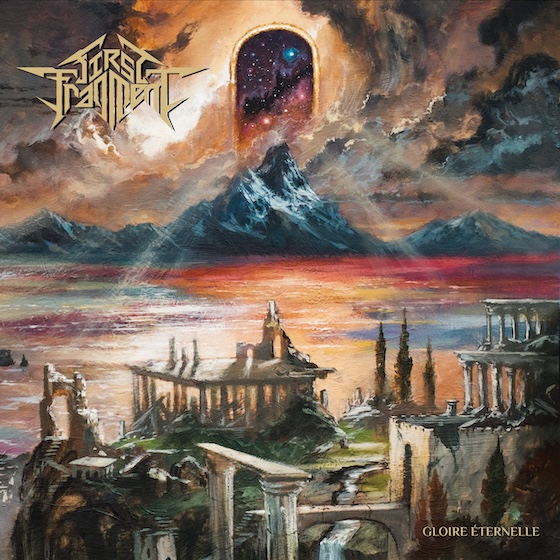
First there is motion. Not riffs—motion. A rush of light across some impossible celestial battlefield. Strings flare like a lost score to an unmade fantasy epic, and then the camera dives. Faster. Faster still. Suddenly you’re in the maelstrom, swallowed whole by spiraling guitars, fretless bass lines moving like serpents through marble corridors, drums detonating beneath your feet. First Fragment doesn't so much begin Gloire Éternelle as unleash it, as if the album had existed in some mythic dimension before being translated—barely—into sound.
And that’s what makes First Fragment’s Gloire Éternelle, an album originally released in 2021 through Unique Leader Records, feel different, even in the absurdly crowded realm of technical death metal. This isn’t just virtuosity as sport. It isn’t flexing for its own sake, though make no mistake, the playing here is frankly preposterous. This is a goddamned spectacle. Cinema. Sword-and-sorcery staged in harmonic minor. You can hear the neoclassical devotion in every twisting lead, every flamenco flourish, every baroque detour that erupts before the next blast-beaten assault. It moves with the grandeur of an epic film, but it breathes with the feral unpredictability of extreme metal.
Hailing from Montreal, Quebec—long a crucible for boundary-pushing extreme metal—First Fragment emerged from a lineage that includes innovators like Gorguts and Cryptopsy, yet they mutate that tradition into something far more extravagant. You can feel that Quebec technical precision in their DNA, but what they do with it is something else entirely: threading neoclassical grandeur, flamenco elegance, and almost mythic cinematic sweep into death metal’s machinery. It gives Gloire Éternelle part of its singular identity—rooted in a legendary scene, but reaching for something almost unreal.
The lineup is a machine built by madmen. Guitarists Phil Tougas and Gabriel Brault-Laroche duel and intertwine like rival protagonists, constantly pushing melody through chaos. Drummer Quentin Gareis plays like he’s chasing the collapse of time itself. Then there’s Dominic Lapointe—whose fretless bass doesn’t merely support these songs but haunts them, coils around them, steals scenes from them. In lesser hands, this could all collapse under the weight of its own ambition. Here, it ascends.
Opening salvo “La Veuve et Le Martyr” wastes no time announcing the film you’ve stepped into. It surges with operatic intensity, balancing impossible shred with themes that feel almost heroic. “Gloire Éternelle” follows and somehow raises the stakes, a title track that feels carved from obsidian and gold, every motif spiraling back in with almost symphonic logic. There’s brutality, yes, but there’s elegance in how these songs unfold, less linear assault than unfolding narrative.
Then comes “Solus,” and things get strange in the best way. There’s a dancing quality here, a swagger hidden inside all the technical violence. You hear the flamenco accents, the classical sensibility, the band refusing to stay confined by genre orthodoxy. “Monumental Mercurial” lives up to its name, all dizzying turns and merciless momentum, while “Pantheum” feels practically architectural—vast, ornate, almost overwhelming in its detail.
But where the record really reveals its soul is in its longer-form pieces. “De Chair et de Haine” is a monster, but one with emotional heft under the mechanics, and “Carpe Diem” injects a startling melodic radiance amid the labyrinth. And then there is “In’El.” What a closer. It doesn’t simply end the album; it feels like the final reel catching fire. Nine-plus minutes of grandeur, violence, transcendence. By the time it resolves, you’re not thinking about how technically impossible any of this is. You’re just staring at the credits.
And yes, people talk about this album’s technicality because how could they not? It sits in conversation with landmarks by Necrophagist, Spawn of Possession, Obscura, even fellow Canadian maniacs Archspire. But Gloire Éternelle has a different heartbeat. It doesn’t feel mechanical. It feels ornate. Human. Feverish. There’s romance in the excess.
That may be the album’s real triumph. For all its “Olympic-level” musicianship—and believe me, it has that in obscene abundance—it never feels cold. Too much modern tech-death can become architecture without blood. First Fragment avoids that trap. Their songs shimmer. They surge. They seduce. This isn’t calculus. It’s delirium wearing armor.
And maybe that’s why Gloire Éternelle lingers long after its final note. It doesn’t just overwhelm; it transports. It plays like an impossible film that exists only when the needle drops, where every solo is a chase sequence, every bass runs a plot twist, every breakdown a collapsing empire. It’s death metal as high fantasy, as operatic adventure, as ecstatic excess.
Ridiculous? Absolutely.
Glorious? Eternally.
The album can be purchased here or wherever the best shredding is passed hand to hand. Celluloid fades. Dissonance remains.