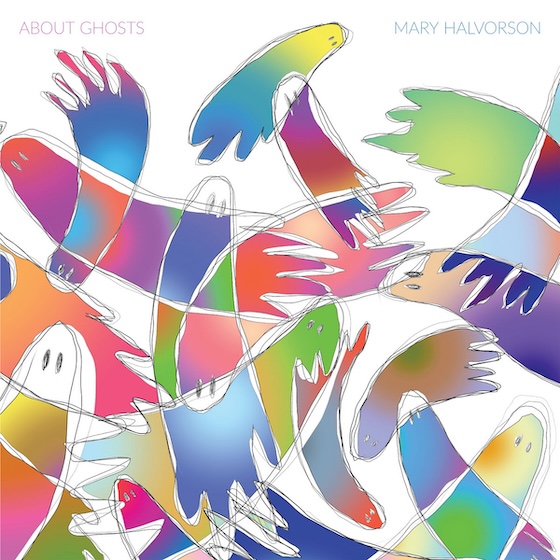
There’s a peculiar kind of loneliness that only certain jazz records understand. Not sadness, exactly. More like urban dissociation. The feeling of sitting in a parked car at 1:17AM outside a diner that never closed, watching neon smear itself across wet asphalt while your coffee goes cold beside you. About Ghosts understands that feeling instinctively — maybe too instinctively.
Mary Halvorson has always operated slightly outside the frame anyway. Even when critics try to canonize her — and they do, relentlessly now — her playing still resists stability. Notes wobble. Chords bend inward at uncomfortable angles. Melodies arrive already half-decayed, as though somebody left the tape too close to a radiator.
And I think that’s why this album works so well late at night. The music never settles into certainty long enough for comfort.
I kept returning to “Carved From,” though I’m not entirely convinced it’s the album’s centerpiece. Maybe it only feels that way because of where I first heard it: headphones on, apartment lights out, some ambulance siren bleeding faintly through the walls three blocks over. The horns rise slowly there — not dramatically, not triumphantly — more like steam escaping damaged pipework in an old building. Halvorson enters afterward almost reluctantly, clipping phrases apart before they fully bloom. She plays like someone crossing black ice carefully.
That hesitation matters.
Too many contemporary jazz records mistake density for depth. About Ghosts avoids that trap because the ensemble leaves tiny fractures everywhere inside the arrangements. Empty pockets. Unresolved tensions. Vibraphone lines shimmer briefly, then disappear before your ear can fully grasp them. The saxophones swell together until they almost sound orchestral, then suddenly turn abrasive and raw around the edges. Nothing resolves cleanly. The record seems suspicious of resolution itself.
Which, honestly, feels emotionally accurate right now.
The production helps enormously. Whoever handled the spatial balance here understood that clarity and atmosphere aren’t mutually exclusive. You can hear the technical interplay without sterilizing the music into conservatory glasswork. Everything retains this humid nocturnal haze — like an old 35mm print screening slightly out of focus in a near-empty revival theater. At moments I found myself thinking less about jazz records and more about films: Thief. Klute. Maybe even Lost Highway if somebody swapped the industrial dread for psychic exhaustion.
Or maybe that’s overstating it. I don’t know.
Still, there’s something undeniably cinematic about the way these compositions move. “Full of Neon” practically flickers. “Eventidal” drifts through the room rather than advancing conventionally. Even silence feels arranged carefully here. Not decorative silence either — loaded silence. The kind where everybody in the scene suddenly stops talking because somebody finally realized something terrible.
Yet the remarkable thing is how warm the album remains underneath all this abstraction. Human warmth. Fallible warmth. The players sound engaged with one another rather than merely executing complexity. That distinction saves the record repeatedly. You hear curiosity instead of calculation.
And maybe that’s the ghost the title points toward. Not memory exactly. Not nostalgia. More like traces. Emotional residue lingering inside the architecture of the music long after the melodies themselves dissolve.
By the end, the album doesn’t conclude so much as recede into darkness. No grand finale. No clean catharsis. Just total disappearance.
Which feels correct. Some records shouldn’t end decisively.
They should haunt.
About Ghosts can be picked up here can be picked up here or wherever the finest of jazz records are sold. Drop the needle. Stay there.