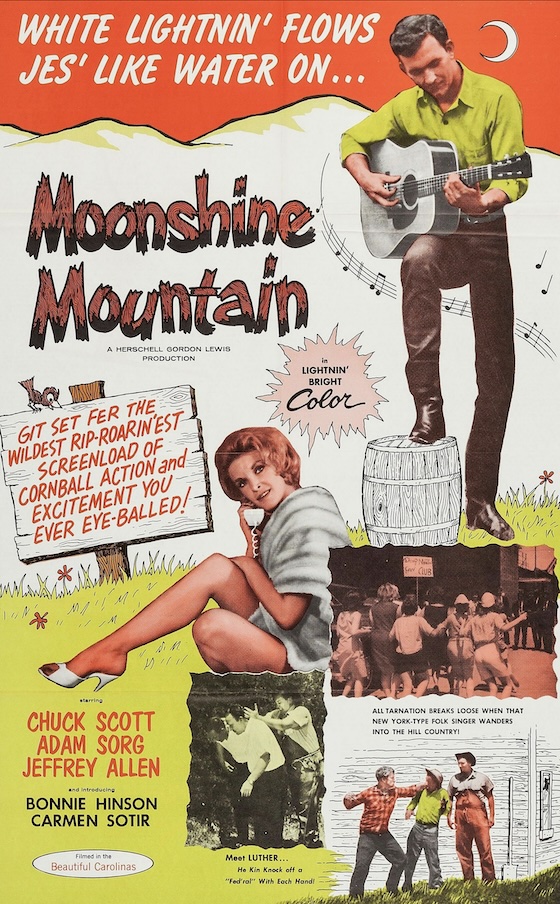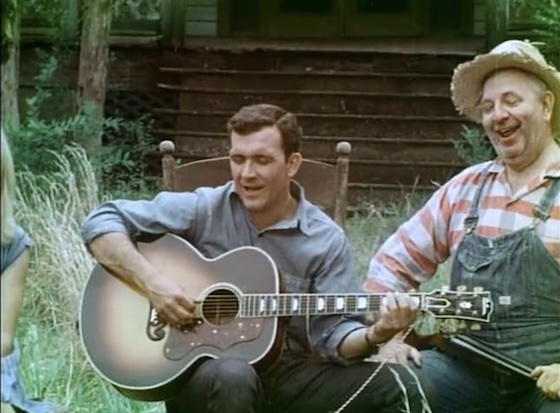
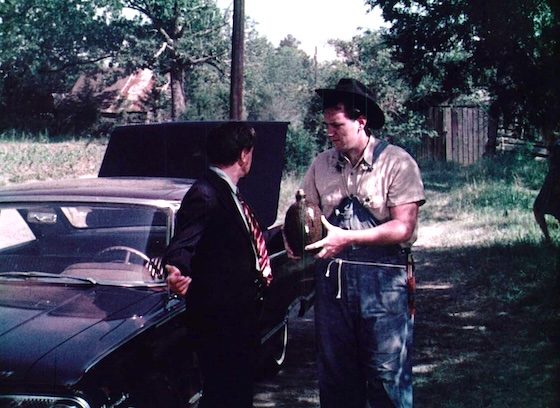
If Herschell Gordon Lewis treated narrative like a polite suggestion in his splatter cycle, he outright hog-ties it and throws it down a ravine in Moonshine Mountain. This one isn’t just backwoods horror-adjacent—it’s a full-throttle hillbilly hallucination, shot like the cameraman wandered into Appalachia with a jug in one hand and a death wish in the other. There’s less carnival-pageantry polish here than in Two Thousand Maniacs!—instead you get raw terrain, sweaty faces, and a sense that anything could happen because no one involved seems particularly interested in rules.
Story coherence? Optional.
Anarchy? Mandatory.
"it’s a swig of pure, undiluted grindhouse venom"In Moonshine Mountain, the “story” staggers in on wobbly legs: a young couple’s romantic road trip into rural Tennessee curdles into a backwoods nightmare when they collide with feuding hillbilly clans, shotgun justice, and a culture steeped in homemade liquor and homemade grudges. What begins as fish-out-of-water melodrama quickly spirals into violence and family vendettas, with the outsiders caught in the crossfire of moonshine dynasties that treat trespassing like a capital offense.
The cast leans hard into the raw, regional exploitation vibe—Willard C. Mitchell anchors the chaos with a grizzled authority figure energy, while Paul Galloway and Bonnie Barnett play the doomed interlopers whose city-bred naïveté curdles into panic. Performances are rough-edged and theatrical, sometimes bordering on the surreal, but that lack of polish feeds the film’s anarchic pulse—everyone seems just a hair away from either breaking into a hoedown or pulling a trigger.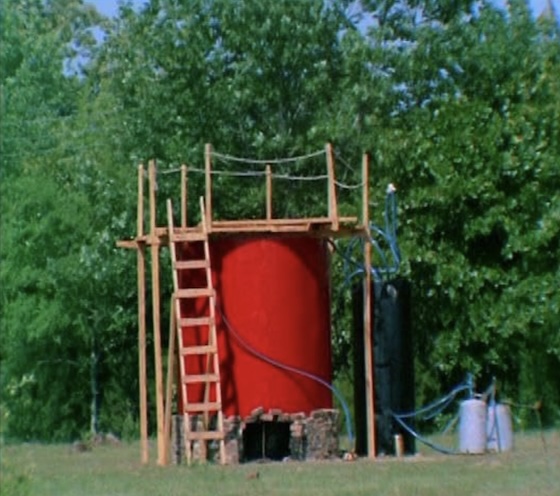
The gore hits harder here because it feels less theatrical and more feral. Where Maniacs staged its carnage like a demented county fair act, Moonshine Mountain swings the blade with a crooked grin and lets the blood fall where it may. The violence isn’t polished spectacle—it’s sudden, scrappy, and mean, as if the film itself is picking a fight with the audience. Lewis leans into the ugliness: backwoods brutality, familial rot, and a sense of doom simmering beneath every jug-passing hoedown. It’s exploitation stripped to sinew and bone.
But the real thrill is the chaos. The camera roams like it’s trespassing, capturing arguments, brawls, and bursts of cruelty with documentary-style recklessness. You feel the humidity, the dust, the low-budget desperation clawing at the edges of every frame. There’s a nihilistic humor running underneath it all—a smirk that says civilization is just a rumor out here, and the only law is whoever’s holding the shotgun. It’s nastier, less playful, and more confrontational than its splatter sibling.
By the end, Moonshine Mountain doesn’t so much conclude as stagger off into the woods, leaving you blinking in the harsh daylight. It’s more gore, more anarchy, less structure—a cinematic bar fight that spills over into horror territory without bothering to clean up the broken glass. For late-night viewers craving something unhinged and unvarnished, it’s a swig of pure, undiluted grindhouse venom.


Home Video Distributor: Arrow Films
Available on Blu-ray - November 10, 2020
Screen Formats: 1.85:1
Subtitles: English
Video: 1080p
Audio: LPCM Mono
Discs: Blu-ray Disc; seven-disc-set
Region Encoding: Locked to Region A
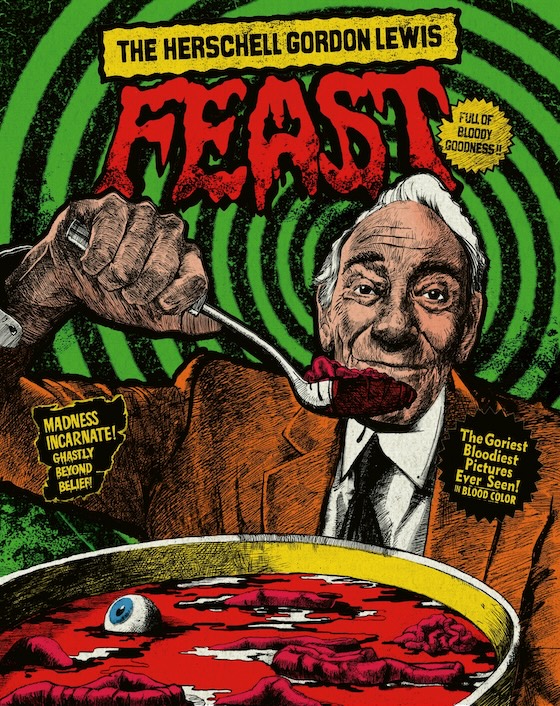
When Arrow resurrected the Herschell Gordon Lewis Feast Blu‑ray box set, it wasn’t just a re‑release — it was a full‑scale archaeological dig conducted by maniacs who love cinema too much to let its weirdest artifacts rot in the swamp. This set arrives like a grindhouse holy text, a lavish, oversized altar to the Godfather of Gore, packed with restorations so crisp you can practically count the brushstrokes on the latex intestines. Arrow treats Blood Feast and its deranged siblings with the reverence usually reserved for Bergman or Kurosawa, which is exactly the kind of cosmic joke H.G. Lewis would appreciate. The packaging is a riot of lurid artwork, the extras are deep‑cut academic fever dreams, and the whole thing feels like a lovingly curated museum exhibit dedicated to the moment American cinema shrugged off good taste and said, “Let’s see what happens if we show EVERYTHING.” It’s not just a box set — it’s a blood‑drenched celebration of outsider filmmaking at its most gloriously unhinged.
Video
Arrow Video’s treatment of Moonshine Mountain feels like an archaeological dig through mud, sweat, and bootleg celluloid—only now the grime is intentional, preserved rather than accidental. The restoration stabilizes the once-wobbly image and deepens the earthy browns and sickly greens of the Tennessee backwoods, giving the bloodshed a thicker, more tactile punch. Grain remains gloriously intact, reminding you this was shot fast and lean, but the clarity upgrade sharpens every hostile glare and shotgun standoff.
Audio
The mono track, cleaned without being scrubbed sterile, lets the twang of regional accents and the bark of gunfire cut cleaner through the chaos. Arrow doesn’t try to “elevate” the film into something respectable—they present it as raw exploitation history, complete with contextual extras that frame Herschell Gordon Lewis’s regional mayhem as a scrappy experiment in outlaw cinema. It’s not pretty, and that’s the point—the presentation honors the dirt while letting you see every speck of it in high definition.
Supplements:
The special features play like a midnight‑movie séance where scholars, weirdos, and exploitation lifers gather to praise the Godfather of Gore. You get archival interviews with Herschell Gordon Lewis himself, where he cheerfully explains how he invented an entire subgenre with pocket change and a pathological disregard for the MPAA. There’s a commentary track featuring Lewis and producer David F. Friedman riffing like two carnival barkers reminiscing about the time they conned America into watching a man hack off limbs with a machete from a hardware store. Arrow also loads the disc with featurettes on the film’s production, the birth of splatter cinema, and the cultural shockwaves that followed. You get outtakes, trailers, radio spots, and the kind of behind‑the‑scenes ephemera that feels like it was rescued from a Florida storage unit moments before the roof caved in. It’s a treasure trove of grindhouse archaeology — a lovingly curated museum of mayhem for anyone who wants to understand how a no‑budget gore flick became a cornerstone of cult cinema.
Commentary:
- See special features
Special Features:
DISC TWO: TWO THOUSAND MANIACS! (1964) & MOONSHINE MOUNTAIN (1964)
- Introduction to the films by director Herschell Gordon Lewis
- Audio Commentary on Two Thousand Maniacs! with Lewis and producer David F. Friedman
- Two Thousand Maniacs! Outtakes
- Two Thousand Maniacs Can’t Be Wrong – Tim Sullivan (director, 2001 Maniacs) on Two Thousand Maniacs!
- Hicksploitation: Confidential – visual essay on the history of the American South’s representation in cinema
- David Friedman: The Gentlemen’s Smut Peddler – a tribute to the legendary producer featuring Herschell Gordon Lewis, filmmakers Fred Olen Ray, Tim Sullivan and Bob Murawski
- Herschell’s Art of Advertising – Lewis shares his expert opinion on the art of selling movies and how to hook an audience.
- Trailers for Two Thousands Maniacs! and Moonshine Mountain

| Movie |  |
|
| Video |  |
|
| Audio |  |
|
| Extras | |
|
|
Composite Blu-ray Grade
|
||